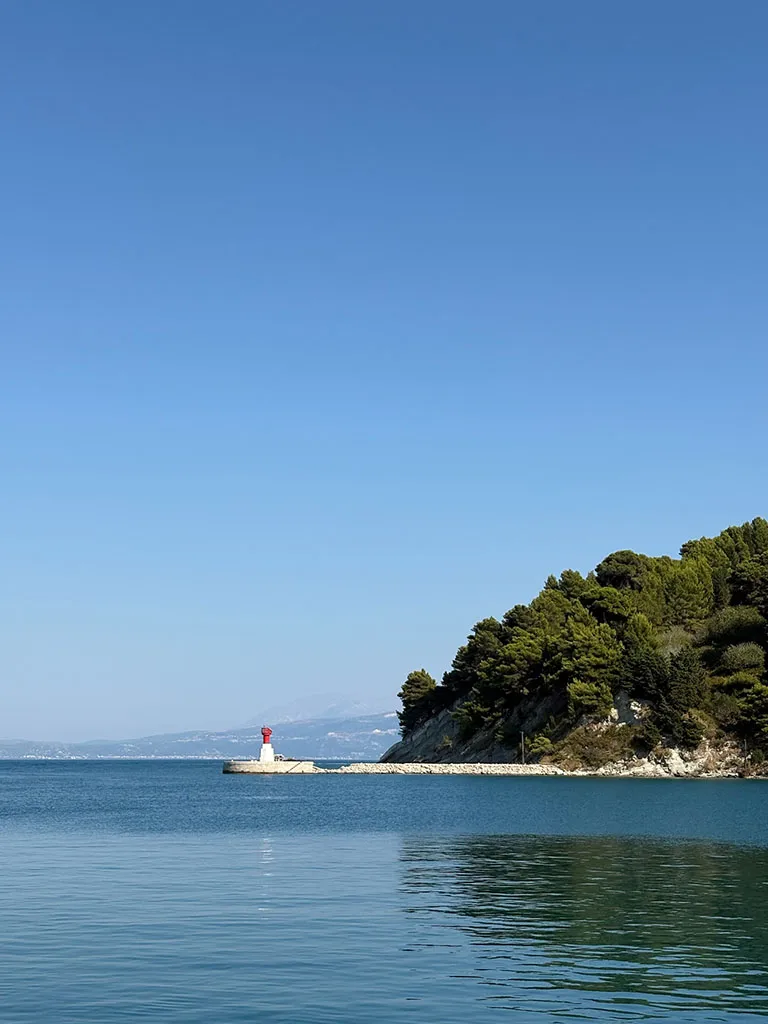
About Sazan Island
Sazan is Albania's largest island, sitting at the mouth of the Bay of Vlore at the point where the Adriatic and Ionian seas meet. It covers roughly 5.7 square kilometres, rises to 344 metres at its highest point, and has a coastline of about 15 kilometres of rocky cliffs, small beaches and capes. Despite its prominent position, Sazan was closed to outside civilians for most of the 20th century. Under communist rule, the island housed soldiers, officers, and their families — which is why it had its own school, cinema, hospital, and basic infrastructure. After the fall of communism it was gradually abandoned, and visits from the mainland only became possible in the 2010s.
Today it is part of the Karaburun-Sazan Marine National Park and open to visitors by boat from Vlore. The island is now uninhabited, with no shops, restaurants or services. Most of what remains was left behind by the military — barracks, bunkers, tunnels running through the hillsides, and thousands of the concrete mushroom-shaped shelters that Enver Hoxha had built across all of Albania during his decades in power. The combination of that abandoned infrastructure against a backdrop of pine forests, clear water and wide coastal views gives Sazan a character unlike anywhere else in the Balkans.
History
Sazan's recorded history stretches back to ancient times — it appears in Greek sources as Sason and in Roman sources as Saso, and a naval battle between Philip V of Macedon and Rome took place off its shores in 215 BC. Over the following centuries it passed through Byzantine, Venetian, Ottoman and British hands before becoming part of Albania.
Its modern history is defined by the Cold War. After World War II, Albania aligned with the Soviet Union and Sazan was transformed into one of the most heavily fortified military installations in the region. The Soviets built a base for Whiskey-class submarines here, along with associated infrastructure, and at its peak the island housed around 3,000 soldiers. When Albania broke with the Soviet Union in the early 1960s, the Soviet presence ended but the Albanian military stayed — and kept building. Enver Hoxha's regime added more bunkers, tunnels and defensive structures, and the island remained completely closed to civilians.
After the fall of communism and the civil unrest of 1997, most of the military gradually withdrew, leaving behind intact buildings, equipment, desks still in classrooms, and gas masks scattered across the hillsides. The island opened to tourists in 2010 and has been accessible by boat from Vlore since then, though military regulations still apply to landing access and certain areas of the island.
What to See on the Island
When landing is permitted (June–November), visitors typically spend around 40 minutes ashore. The main area accessible to tourists is the former military settlement near the island's pier — a cluster of low buildings that once served as barracks, a school, a hospital, a canteen and a cinema. Most are still standing and largely as they were left, which gives the site an eerie, frozen-in-time atmosphere. The school desks are still inside the classrooms. Bunkers line the road through the pine forest above the settlement.
The coastline around the pier also has a small pebble beach where visitors can swim in clear water. It is worth noting that the island has no facilities of any kind — no shade structures, no seating, no food or water available — so everything you need must come with you on the boat.
Outside the permitted tourist area, access is restricted. The island still has an active Italo-Albanian naval post and landmines remain in parts of the interior. Guides on the tour will indicate where it is and is not safe to go.
Nature & Wildlife
Despite its military past, Sazan has a rich and largely undisturbed natural environment. The island has a distinct microclimate — warmer and more humid than the mainland — that supports dense pine forest across its slopes alongside Mediterranean shrubs including juniper, myrtle and wild olive. Several plant species found on the island are rare or endemic to the region.
The island sits on a migratory bird route and supports 39 recorded bird species including raptors, pigeons and swifts. Fifteen mammal species have been documented including eight bat species. The surrounding marine area, protected as part of the national park, has excellent water clarity and supports diverse underwater life — the absence of development and the limited visitor numbers have kept the ecosystem in good condition.
Key Facts
5.7 km² — the largest of Albania's islands. The island is 4.8 km long and 2 km wide with about 15 km of coastline.
344 metres above sea level, with three other peaks ranging from 228 to 331 metres.
Active Soviet and Albanian military base from the 1940s until the 1990s. Housed up to 3,000 soldiers and a Soviet submarine base.
2010. Landing is currently permitted from June to November due to ongoing military zone regulations.
Part of the Karaburun-Sazan Marine National Park, designated in 2010 covering 2,721 hectares of surrounding marine area.
Approximately 15–16 km. Around 40 minutes by speedboat from Vlore marina.
How to Visit
The only way to reach Sazan is by boat from Vlore — there is no ferry service and no other access point. Our Sazan Island & Haxhi Ali Cave tour runs three times daily and includes a stop at the island. The tour also visits Haxhi Ali Cave and includes extended free time at a Karaburun Peninsula beach.
If you want to land on the island and explore the military settlement, book between June and November. If you visit outside that window the boat will still approach the island and you will see the coastline and pier from the water — a different experience but still worth it for the views and the context.
There is nothing to buy on the island, so bring water, sunscreen and anything else you need. Comfortable footwear is recommended if you plan to walk through the site. The beach near the pier is accessible for swimming when landing is permitted.
Frequently Asked Questions
Landing is permitted from June to November. Outside this period the boat approaches the island pier but passengers remain on board due to the island's active military zone status.
At the entrance of the Bay of Vlore, approximately 15 km from Vlore and 40 minutes by speedboat. It sits at the geographic point where the Adriatic and Ionian seas meet.
Its position controlling the entrance to the Bay of Vlore and the Strait of Otranto made it highly strategic. During the Cold War the Soviets built a submarine base here. Albania's communist regime later expanded the military infrastructure further.
Abandoned Soviet-era barracks, a school, hospital, cinema and bunkers — all largely intact since the military left. A small beach near the pier is accessible for swimming. The surrounding waters are exceptionally clear for snorkeling.
By booking our Sazan Island & Haxhi Ali Cave tour from Vlore. It departs three times daily and includes a stop at the island along with Haxhi Ali Cave and a Karaburun beach stop.