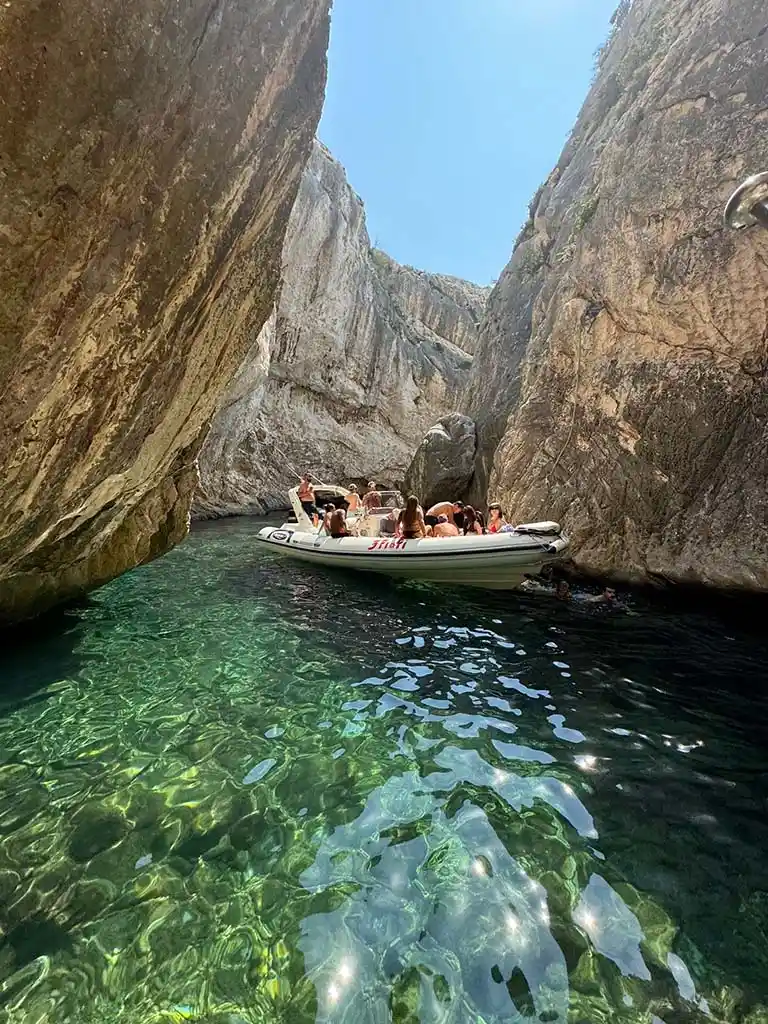
The western shore of the Karaburun Peninsula stretches for 35 kilometres between Vlore Bay and the open Ionian Sea. There are no roads along it. No hotels, no villages. The terrain rises directly from the water into limestone cliffs that in places exceed 200 metres. Everything along this coastline is exactly as it has always been, and the only way to see it is from a boat.
This is not a marketing claim — it is a geographic fact. The peninsula was a restricted military zone for most of the 20th century, which meant no development took place and no infrastructure was built. When the restrictions lifted, the coast was left as it was. It is now a national park, and the absence of road access is permanent.
What follows is a guide to each of the significant destinations along the Karaburun coast — what they are, what makes them worth the trip, and which tours visit them.
Haxhi Ali Cave
Haxhi Ali Cave is the first major stop on the Karaburun coast heading south from Vlore. The cave is a large sea cavern with a limestone arch at its entrance wide enough for a speedboat to enter directly. The interior is a single vaulted chamber, roughly 30 metres deep, where the walls and water are lit by natural light reflecting off the surface.
The cave has been visited by local fishermen for centuries and takes its name from a figure in Albanian folk tradition. It is the most well-known destination on the Karaburun coast and the anchor stop of every tour departing from Vlore.
The Secret Blue Cave
The Secret Blue Cave sits in Lloviz Bay, a few kilometres south of Haxhi Ali. It is not visible from the water until the boat is almost at the entrance — the opening is narrow and set into the cliff face at water level. Inside, the cave opens into a larger chamber where the floor is shallow and the water is illuminated from below by sunlight entering through a submerged opening in the rock.
The effect, when conditions are right, is an intense, vivid blue glow that fills the water and reflects onto the cave walls. It only occurs when the sun is at the right angle — typically between late morning and early afternoon. The full-day tour is timed to reach this cave within that window.
This stop is exclusive to the full-day Grama Bay tour. It is not accessible on the half-day tours.
The Canyon of Smugglers
Further south, the coastline breaks into a narrow rock passage known locally as the Canyon of Smugglers. The gap between the cliff faces is tight enough that the boat passes through at low speed, with limestone walls rising on both sides. The passage is navigable only by small speedboats — nothing larger can fit through.
The name comes from the use of this passage by smugglers running goods between Albania and Italy during the years when cross-Adriatic trade operated outside official channels. The geography made it a natural hiding point. Today it is simply one of the more dramatic stretches of the route — the kind of place that is difficult to photograph accurately because the scale only registers in person.
This stop is on the full-day tour only.
Dafina Bay
Dafina Bay is a mid-route swimming stop on the full-day tour, situated roughly halfway between Vlore and Grama Bay. The bay is enclosed on three sides by low limestone terraces that descend directly into the water. The water is calm, clear and shallow enough to see the bottom clearly at 5–6 metres.
There is nothing here except the water and the rock. No facilities, no other boats in most conditions, no noise. It is a stop that exists purely for swimming, and it is one of the quieter and more overlooked points on the route.
Englishman Bay
Englishman Bay takes its name from a British sailor who, according to local accounts, used the bay as a regular shelter point in the early 20th century. The bay has a small pebble beach backed by low cliffs and is one of the few points on the western Karaburun coast where landing is easy. The water colour shifts from deep teal in the middle of the bay to a pale green near the shore where the bottom is visible.
Like Dafina Bay, there are no facilities and no road access. The bay sees the boat tours from Vlore and occasionally a private vessel, but nothing else. In early and late season it is frequently empty.
Grama Bay
Grama Bay is the furthest point on the full-day tour route and the destination the tour is named after. It is approximately 1 hour and 20 minutes by speedboat from Vlore, enclosed on three sides by limestone cliffs that rise to around 200 metres.
The bay has two features that set it apart from anything else on the Albanian coast. The first is the water: visibility regularly exceeds 20 metres, the colour is a deep and consistent turquoise that changes character through the day as the sun moves across the cliff tops, and the stillness inside the bay means the surface is often perfectly flat even when conditions outside are choppy.
The second is the inscriptions. Carved into the limestone walls at the waterline — some at water level, some just above — are approximately 2,000-year-old Greek and Roman texts recording the names of sailors and ships that sheltered here. Grama Bay was a natural harbour on the ancient maritime route between the Adriatic and the eastern Mediterranean. The inscriptions are not behind glass, not roped off, not in a museum. They are simply there, on the rock face, at the edge of the water.
The tour allows around 2.5 hours at Grama Bay for swimming, snorkelling and exploring the inscriptions along the cliff base. Food and drinks are served on board before the return journey.
Sazan Island
Sazan Island sits at the entrance to Vlore Bay, roughly 15 km from the mainland. For most of the 20th century it was a closed military zone — first a Soviet submarine base from the 1950s until 1961, then an Albanian naval installation until the military withdrew in the 1990s. The island was sealed from public access until 2010.
What the soldiers left behind is still largely intact: barracks, a school, a hospital, a cinema, a lighthouse, and thousands of the concrete bunkers that were built across Albania during the Hoxha era. The buildings are empty and weathered but structurally present. The island has an active naval post, which is why landing is only permitted from June to November and visitors are accompanied during the visit.
Sazan is not part of the Karaburun tour route — it is a separate half-day tour paired with a visit to Haxhi Ali Cave. But it belongs in any account of the boat-only destinations from Vlore because the island is completely inaccessible except by water and its combination of Cold War history and Ionian setting is unlike anything else in the region.
Which Tour Visits Which Destinations
Not all of these destinations are on every tour. Here is a clear breakdown:
The full-day Grama Bay, Blue Cave & Haxhi Ali Cave tour covers all eight stops along the Karaburun coast: Haxhi Ali Cave, the Secret Blue Cave, the Canyon of Smugglers, Dafina Bay, Englishman Bay, Church's Cave and Grama Bay. It is the only tour that visits the Secret Blue Cave and the Canyon of Smugglers. Duration is approximately 8 hours with food and drinks included. Departs 10:30 AM.
The Sazan Island & Haxhi Ali Cave tour visits Sazan Island and Haxhi Ali Cave, with a beach stop on the Karaburun coast. Duration 5 hours. Departs 09:00, 11:30 and 14:30. Landing on Sazan is permitted June to November only.
The Haxhi Ali Cave & Karaburun tour visits Haxhi Ali Cave and a Karaburun beach. Duration 4 hours. Departs 09:00, 11:30 and 14:30.
The Sunset Wine Tour visits Haxhi Ali Cave timed around golden hour. Duration approximately 1.5 hours. Departs around 50 minutes before sunset. Wine and fruit included.
Final Thoughts
The Karaburun coast remains one of the last untouched stretches of the Mediterranean. Exploring it by boat from Vlore is not just the easiest way — it is the only way.
Frequently Asked Questions
The Karaburun Peninsula is a protected national park with no road access along its western shore. The terrain rises steeply from the water and the coastline was never developed. The only way to reach the bays, caves and coves along the western face is by boat from Vlore.
The Secret Blue Cave is a sea cave in Lloviz Bay on the Karaburun Peninsula. Sunlight enters through a narrow underwater opening and illuminates the interior with an intense blue glow. It is one of the stops on the full-day Grama Bay tour — not accessible on the half-day tours.
Approximately 2,000 years old, dating from the Greek and Roman periods. They record the names of sailors and ships that sheltered in the bay and are carved directly into the limestone at the waterline — not behind glass, not roped off.
The full-day Grama Bay, Blue Cave and Haxhi Ali Cave tour covers all eight stops along the Karaburun coast including Haxhi Ali Cave, the Secret Blue Cave, the Canyon of Smugglers, Dafina Bay, Englishman Bay, Church's Cave and Grama Bay. It departs at 10:30 AM and runs for approximately 8 hours. Food and drinks are included.
Not practically. There are no roads to the western Karaburun coast and no public boat services. Private boat hire is available in Vlore but requires navigating unfamiliar coastal terrain. The organised tours from Maris Vlora are the standard and most practical way to visit these destinations.